
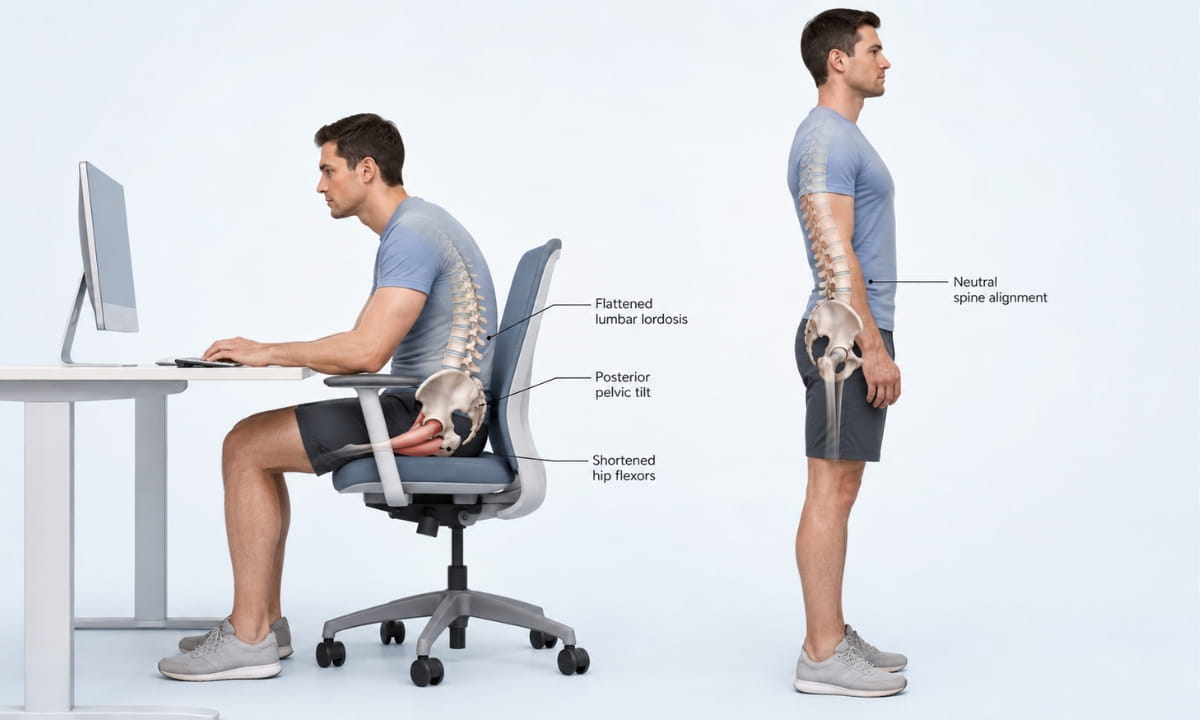
Sitting-specific low back pain usually isn’t about one single cause. It’s most often driven by a combination of posterior pelvic tilt (which flattens the lumbar curve under load), shortened hip flexors that pull the pelvis out of neutral once you stand back up, and, despite the popular claim, disc pressure itself, which recent research shows is not consistently higher in sitting than standing. If pain resolves with movement, it’s a strong clue the driver is postural and muscular, not purely structural.
It’s Not “Just Disc Pressure” the Evidence Is More Mixed Than You’ve Heard
For decades, patients have been told sitting compresses the discs more than standing, based on Alf Nachemson’s 1960s–70s intradiscal pressure (IDP) measurements. That idea has become almost a truism in wellness content. But it doesn’t hold up cleanly against more recent in-vivo data.
[Likely] A 2022 systematic review and meta-analysis pooling ten in-vivo studies found sitting produced significantly higher IDP than standing only when older studies were weighted into the average, and when the analysis was restricted to studies published after 1990, or to patients with degenerated discs, the difference between sitting and standing disappeared entirely. Separately, a direct telemetry study using an implanted pressure transducer found the opposite of the popular claim: it did not confirm that spinal load is higher in sitting compared with standing.
What this means clinically: if a patient’s pain is sitting-specific, “disc pressure” is not automatically the correct or complete explanation, particularly if imaging shows disc degeneration, where the sitting/standing IDP difference tends to vanish. The more consistent driver in that population is postural and muscular, not purely hydraulic.
Posterior Pelvic Tilt Flattens Your Natural Curve
When you sit, especially in a chair without lumbar support, the pelvis tends to rotate posteriorly. This flattens the lumbar lordosis. the natural inward curve of the low back, and shifts load onto the posterior annulus and facet joints rather than distributing it evenly through the vertebral body. Over a sustained period (the average desk worker sits 60–70% of the workday), that sustained flexion moment is a more consistent aggravator than momentary pressure differences.
Hip Flexor Shortening Changes What Happens When You Stand
This is the part patients rarely connect. If the hip flexors (especially iliopsoas) adaptively shorten from hours of hip flexion while seated, standing up doesn’t return the pelvis to neutral, the shortened hip flexors pull the pelvis into anterior tilt, increasing lumbar lordosis and facet joint loading at the moment of standing. Some patients feel a sharp catch or ache specifically in the transition from sitting to standing, which is a hip flexor-driven pattern rather than a pure disc issue.
This is also why pain that’s absent during walking is not necessarily reassuring on its own, walking involves reciprocal hip extension that can temporarily lengthen the hip flexors again, masking the adaptive shortening until the next long sitting bout.
Why Walking and Standing Often Feel Fine
Both activities involve continuous small postural adjustments and alternating muscle activation that prevent any one structure, disc, facet, or muscle, from bearing sustained, unchanging load. Sitting removes that variability. The “static loading” itself, more than any single tissue’s absolute pressure, is likely the more accurate unifying explanation.
When to Take Sitting-Specific Pain More Seriously
Sitting-dominant pain that also radiates below the knee, is accompanied by numbness or tingling, or worsens specifically with coughing or straining warrants differentiation from a disc herniation with nerve root involvement, a different mechanism from the postural pattern described above, and one that benefits from a hands-on exam rather than self-diagnosis from a symptom pattern alone.
“Sitting-specific back pain is rarely about one tissue. It’s the interaction of pelvic position, hip flexor length, and sustained static loading, and the popular ‘disc pressure’ explanation is more contested in the research than most patients are told.”
“If your pain eases the moment you start moving, that’s not a coincidence, it’s diagnostic information.”
How Chiropractic Care Fits Into Resolving Sitting-Specific Back Pain
Because sitting-specific pain is typically driven by joint mechanics, muscle length, and movement patterns rather than a single structural lesion, it responds well to an approach that addresses more than one of those variables at once.
Assessment and adjustment. A chiropractic exam differentiates where the restriction actually is, facet joint hypomobility from sustained flexion, sacroiliac involvement from pelvic tilt, or a hip flexor–driven pattern at the sit-to-stand transition, rather than treating “low back pain” as one uniform diagnosis. Chiropractic adjustment restores joint motion in the segments that have been loaded asymmetrically, which is often what allows the surrounding muscles to actually release rather than continuing to guard.
Guidance beyond the table. Adjustment addresses the joint restriction, but the pattern that created it, hours of static hip flexion, a chair that encourages posterior pelvic tilt, a desk setup that reinforces forward flexion — will keep reproducing the problem if it isn’t also changed. This is where a chiropractor’s scope extends past hands-on treatment: reviewing desk and chair setup, building in movement breaks at an interval that actually interrupts static loading (not just “get up sometimes”), and prescribing targeted hip flexor and glute work, hip flexor stretching to reverse adaptive shortening, and glute/deep core activation to support pelvis position once you stand, so the tissue changes are reinforced between visits rather than undone by the next long sitting block.
Why the combination matters. Adjustment alone, without addressing the sustained postural input, tends to produce short-lived relief that recurs on the same schedule as the sitting pattern. Habit and exercise changes alone, without correcting existing joint restriction, are slower and less complete. Used together, they address both the mechanical restriction and the behavior that’s loading it.
Key Takeaways
- The long-standing claim that sitting always raises disc pressure more than standing does not hold up consistently in recent in-vivo research, especially in patients with disc degeneration.
- Posterior pelvic tilt during sitting flattens the lumbar curve and shifts load onto the posterior spinal structures.
- Adaptively shortened hip flexors can produce pain specifically at the sit-to-stand transition, not just during sitting itself.
- Pain that resolves with movement points toward a postural/muscular driver; pain with radiation, numbness, or pain on coughing/straining needs an in-person evaluation to rule out nerve root involvement.
FAQ
Does sitting really put more pressure on spinal discs than standing?
Not consistently. [Older studies suggested this, but a 2022 meta-analysis found the sitting-vs-standing pressure difference disappears in more recent studies and in people with disc degeneration.
Why does my back hurt more after sitting than after walking?
Sitting holds the spine in a sustained, unchanging position, often with a posteriorly tilted pelvis, while walking involves continuous movement that varies the load and prevents any single structure from staying under constant stress.
Can tight hip flexors cause lower back pain?
Yes. Shortened hip flexors from prolonged sitting can pull the pelvis into anterior tilt when you stand, increasing lumbar curve and joint loading right at that transition point.
Can a chiropractor help with back pain that only happens when sitting?
Yes. Chiropractic care can address the joint restriction and muscle guarding driving the pain, and — just as importantly — help identify and correct the specific sitting habits, desk setup, and hip flexor tightness that are reproducing it.
Do I need exercises in addition to adjustments for sitting-related back pain?
Often, yes. Adjustments address joint restriction, but targeted hip flexor stretches and core/glute activation help prevent the same postural pattern from recreating the problem between visits.
When should sitting-related back pain be evaluated by a professional?
If pain radiates below the knee, comes with numbness or tingling, or worsens with coughing or straining, those are signs to have it assessed rather than assumed to be purely postural.
Related Reading
- Back Pain condition page
- Chiropractic Adjustment service page
- “Midtown Desk Workers” post
- Sciatica / Radiating Pain condition page (for the differentiation section)
References
- Comparison of In Vivo Intradiscal Pressure between Sitting and Standing in Human Lumbar Spine: A Systematic Review and Meta-Analysis. PMC8950176. https://www.ncbi.nlm.nih.gov/pmc/articles/PMC8950176/
- Wilke HJ, et al. Comparison of intradiscal pressures and spinal fixator loads for different body positions and exercises. PubMed 11450876. https://pubmed.ncbi.nlm.nih.gov/11450876/
- Roman-Liu D, et al. Differences in lumbar spine intradiscal pressure between standing and sitting postures: a comprehensive literature review. PeerJ. PMC10590571. https://www.ncbi.nlm.nih.gov/pmc/articles/PMC10590571/
Article by Aleksander Kanevsky, DC, CFMP
 At New York City Chiropractic and Functional Medicine Center, Dr. Aleksander Kanevsky provides Chiropractic Care, Bioenergetic Medicine, Functional Medicine and Nutrition. Dr. Kanevsky demonstrates why this type of integrative care is an essential addition to a health care practice. He helps people to achieve quality of life and highest expression of health.




