
When a properly collected hair sample is analyzed by a reputable laboratory, HTMA can provide a consistent and clinically useful picture of mineral patterns and toxic-metal exposure over approximately three to four months. Unlike a single blood test, it may reveal longer-term trends in mineral balance, metabolism, stress response, and nutrient utilization that routine testing can miss. I have used HTMA for eight years and currently rely on Trace Elements, Inc. for analysis. I interpret the results alongside symptoms, health history, physical findings, diet, medications, and relevant bloodwork. HTMA is not a stand-alone diagnosis, but when used responsibly, it can be a powerful map for developing more individualized nutrition, supplementation, detoxification, and lifestyle strategies.
Is Hair Tissue Mineral Analysis Accurate? What You Can Count On
Is hair tissue mineral analysis accurate? In the way that matters most for a lab test, yes. When a properly collected sample is run by a reputable lab, HTMA gives reproducible results. What those results mean is a matter of clinical interpretation, which is why I read them alongside symptoms, history, and bloodwork.
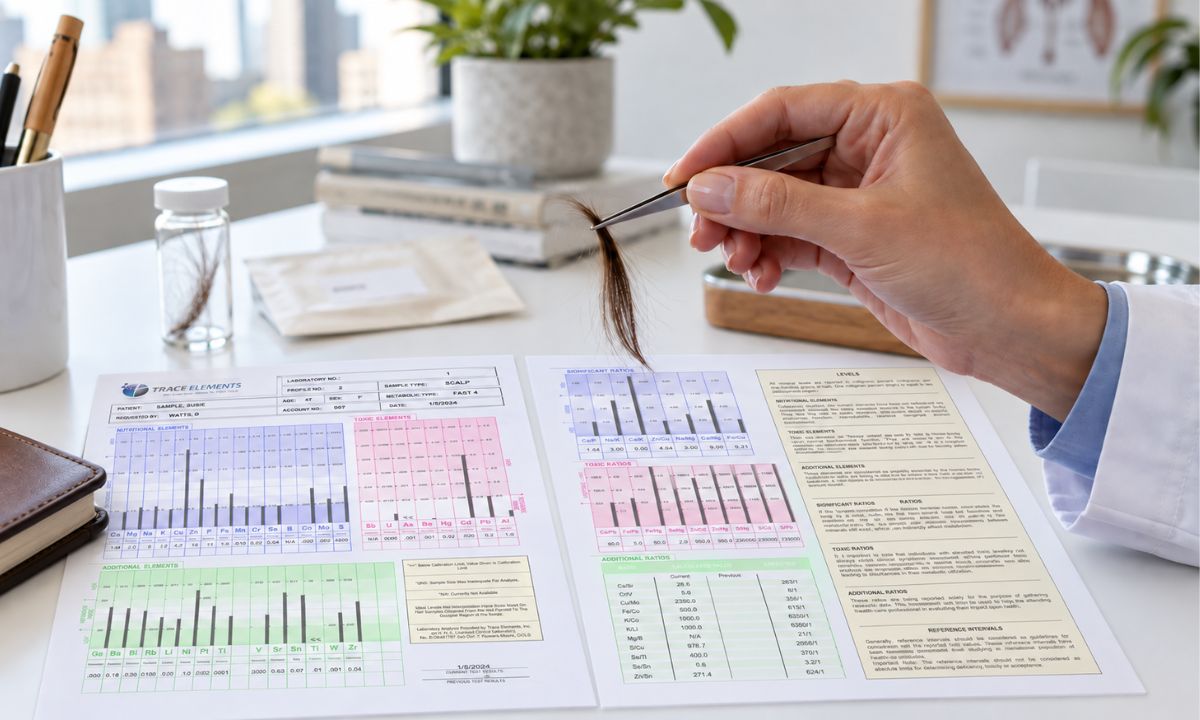
Hair tissue mineral analysis, or HTMA, measures minerals and some toxic metals in a small sample of scalp hair. Hair takes in minerals from its blood supply as it grows and locks them in, so the sample reflects several months of growth.
It is also widely used. Trace Elements, Inc., the lab I work with, reports processing more than 1.5 million HTMA specimens and serving health professionals in over 46 countries. HTMA is most common in functional and integrative medicine, where practitioners use it to recognize patterns. It is not a mainstream diagnostic test, and it is not a diagnostic test in my hands either.
Full transparency. I offer HTMA in my Midtown East practice, I use Trace Elements as my lab, and I co-founded a supplement company called AgeImmune. Because of that, I will be specific about what I can and cannot support.
Is HTMA Reliable? Why Reproducible Results Matter
Yes. When a properly collected sample is run by a reputable lab, HTMA results are reproducible, and that is the foundation of everything else.
A 2013 study sent split hair samples to three commercial labs and found that they produced consistent numerical results. The catch was that each lab used different reference ranges, so each interpreted the same numbers differently. An earlier 2001 JAMA study found much larger disagreements between labs. That study is 25 years old, and methods have improved, but it is the reason I stay with one lab and compare a retest only against earlier results from that same lab.
In eight years with the same lab, I have found HTMA remarkably consistent. When a result seems to clash with a patient’s symptoms or bloodwork, the pattern usually makes sense once I read the full picture instead of a single mineral. When it does not, I check for contamination from hair treatments or medicated shampoos, review how the sample was collected, avoid aggressive changes, and repeat the test when appropriate.
What Does HTMA Show About Thyroid and Adrenal Function?
In my practice, HTMA gives me a tissue-level view of thyroid and adrenal activity through mineral ratios, and I use that view to decide what to address first.
I read the calcium to potassium ratio as a marker of thyroid hormone effect at the tissue level. I read the sodium to magnesium ratio as a marker of the adrenal stress response. Calcium to magnesium and sodium to potassium add clues about blood sugar handling, cellular energy, and stress resilience.
HTMA does not diagnose thyroid or adrenal disease, and it does not replace thyroid and adrenal lab testing. These ratio readings come from the clinical framework behind HTMA, not from independent validation studies, so I treat them as strong clinical clues and confirm them against symptoms, history, and bloodwork.
This is where HTMA earns its place for me. When symptoms persist and standard labs look normal, the mineral pattern gives me a new question to investigate. You can read how the ratios are laid out in what an HTMA report measures and how the ratios are read.
A Case Study: Digestive Symptoms With Normal Bloodwork
One patient’s story shows how HTMA can redirect an investigation.
A patient came to me with persistent digestive complaints. Conventional bloodwork, including standard thyroid markers, did not reveal an obvious problem that explained the symptoms. The HTMA showed an elevated calcium to potassium ratio, a pattern I read as reduced thyroid hormone effect at the tissue level.
Instead of managing the digestive symptoms alone, we supported thyroid function and the underlying mineral pattern, and we addressed nutrition and digestion directly. Over time, the digestive complaints gradually resolved. For how I evaluate thyroid function with standard labs, see how we identify and manage thyroid disorders.
To be precise about what this shows, we changed several things at once, so I cannot say which one mattered most. HTMA did not diagnose anything. It changed the direction of the investigation and pushed me to look for an upstream contributor instead of only treating the downstream symptom.
Hair Mineral Analysis vs Blood Tests: Which Is More Accurate?
They measure different things, and I use both.
Blood is a snapshot of what is circulating today. Hair reflects minerals incorporated over several months. Blood is also tightly regulated, so it can look normal while stores elsewhere shift. The NIH Office of Dietary Supplements notes that serum magnesium does not accurately reflect total body magnesium, and that no single method of assessing magnesium status is considered satisfactory.
That is why bloodwork stays first for anything diagnostic, and HTMA adds context. Two tools looking at different time windows will not always match, and a mismatch does not tell you which one is right.
How to Protect the Accuracy of Your HTMA Results
Good results start with good collection and one consistent lab.
- Skip zinc or selenium shampoos: Medicated and anti-dandruff shampoos can add minerals to the outside of the strand. My instructions ask for at least two weeks without them.
- Wait after coloring: I ask patients to wait at least six weeks after hair dye. Chemical treatments such as permanent waves can change measured levels [6].
- Follow the collection steps: Sample location, length, and amount matter, so I give written and video instructions.
- Use the same lab every time: Reference ranges differ between labs, so compare a retest only with results from the same lab.
- Know the lab’s methods: Trace Elements does not pre-wash hair with harsh solvents, on the reasoning that washing can strip electrolytes such as sodium and potassium. Other labs wash to remove surface contamination. Both choices carry trade-offs.
What the Research Does Not Yet Show
Reproducibility is well supported, but independent research has not yet confirmed that hair mineral ratios measure thyroid or adrenal function.
A 2011 critical review of hair analysis found that, for mineral analysis in particular, interpretive success has been limited compared with the effort invested. A 2025 pilot study did not find a significant relationship between blood and hair minerals in healthy adults, and its authors argued that hair captures longer-term trends [4]. One co-author works for Trace Elements, so read it as informative, not independent.
Hair has its strongest research support as a marker of exposure to certain toxic metals, especially methylmercury from fish [5]. So is hair tissue mineral analysis accurate for reading thyroid and adrenal function? That part remains a clinical framework, not a proven standard. It is the reason I never use HTMA alone, and the reason you should be cautious of anyone who does.
How I Use HTMA in My Midtown East Practice
I use HTMA as one input in a broader functional medicine assessment, never as a stand-alone diagnosis.
I have offered hair tissue mineral analysis in Midtown East, NYC for about eight years, working with a CLIA-licensed laboratory. I place mineral patterns next to symptoms, medications, diet, history, and bloodwork. I do not act on a single high or low mineral. The pattern influences the order in which I address nutrition, mineral support, and stress regulation.
In my experience, patients who follow the plan usually show movement in their mineral pattern on retest. I keep in mind that changing your intake changes what appears in hair, and that better food, sleep, and stress habits can improve symptoms on their own.
Transparency About Supplements
Mineral results can lead to supplement recommendations, so you deserve to know how I handle them.
I frequently use Trace Elements formulations as a starting point. That lab both tests hair and sells nutritional products. I sometimes recommend a customized compounded formula, based on symptoms, physical assessment, diet, medications, history, and bloodwork, not the hair report alone. I avoid aggressively supplementing a mineral just because its hair level looks low.
AgeImmune, the brand I co-founded, is used for broader nutritional support, not as a substitute for a targeted HTMA protocol. You are never required to buy it. Before testing, I explain that HTMA does not diagnose disease and does not replace bloodwork or medical evaluation.
Lifestyle Foundations That Matter Whatever Your Hair Test Shows
Food, sleep, stress regulation, movement, hydration, and digestion shape mineral balance for everyone, with or without a test. This section is education, not a personal plan, so check specifics with your own clinician.
Protein, Whole Foods, and Digestion
Minerals arrive through food, so what you eat and how well you digest it come first. Supplements can help correct a deficiency, but they cannot make up for a diet low in protein and whole foods. Protein supports nutrient transport, tissue repair, and enzyme production, and poor digestion can limit absorption.
Stress, Sleep, and Movement
Chronic stress and magnesium status appear to influence each other. A 2020 review proposed a vicious circle in which stress may increase magnesium loss and low magnesium may heighten sensitivity to stress [8]. Sleep supports hormonal regulation and recovery, and regular, manageable movement improves circulation and insulin sensitivity. Chronic sleep deprivation and constant stress are hard to out-supplement.
Who Might Consider HTMA, and How to Decide
HTMA makes the most sense as an added lens for people working with a knowledgeable practitioner, not as a do-it-yourself project.
Start by discussing the test’s purpose and limits with a practitioner experienced in interpreting it. Use it to add context and guide better questions, not to self-diagnose or launch an aggressive supplement program from isolated numbers. Ask these questions first:
- Which lab do you use, and do you compare results only within that lab?
- How should I collect the sample, and what could contaminate it?
- What decision will this result change?
- Do you or the lab sell the supplements you might recommend?
- Will you check the result against my bloodwork and history?
- When would you repeat the test, and why?
Key Takeaways
- Is hair tissue mineral analysis accurate? It is reliable in the lab: results are reproducible when a good sample is run by the same reputable lab.
- HTMA is widely used in functional and integrative medicine, and my lab reports over 1.5 million specimens processed.
- I use calcium to potassium and sodium to magnesium ratios as a tissue-level view of thyroid and adrenal activity, as a clinical framework and not a diagnosis.
- Independent research has not yet confirmed those ratio readings, so I never use HTMA alone.
- Hair treatments, medicated shampoos, and collection technique can change results, so follow instructions and use one lab.
- Blood and hair measure different time windows, so I use both.
- Improvement after a plan does not prove any single test, because food, sleep, and stress habits help on their own.
The Better Question to Ask About HTMA
Is hair tissue mineral analysis accurate? After eight years, I believe the lab result is dependable, and the more important question is how well it is interpreted.
Used with care, HTMA points me toward questions I might not otherwise ask, especially when symptoms persist and standard labs look normal. The best results come from a practitioner who uses it as one clue among many.
So here is the question I leave with you. What would you want your practitioner to check before acting on any single test result?
Frequently Asked Questions
Is hair tissue mineral analysis accurate?
Yes, in terms of reproducibility. When a properly collected sample is run by a reputable lab, results are consistent, and using the same lab each time keeps comparisons meaningful. How the ratios are interpreted is a clinical framework, so results are best read alongside symptoms, history, and bloodwork.
Is HTMA reliable?
Reliability depends on the lab. A 2013 study found consistent numbers across three labs on split samples, though each used different reference ranges. An older 2001 study found larger disagreements. Using one lab and following collection instructions gives you the most dependable comparison.
Is HTMA widely used?
Yes, mainly in functional and integrative medicine. Trace Elements reports processing over 1.5 million specimens and serving health professionals in more than 46 countries. It is not a standard test in conventional primary care.
Can HTMA diagnose thyroid or adrenal problems?
No. HTMA does not diagnose disease. I use ratios such as calcium to potassium and sodium to magnesium as a tissue-level clue about thyroid and adrenal activity, then confirm with symptoms, history, and bloodwork. Anyone with thyroid concerns should also have standard thyroid testing.
What is the difference between HTMA and a blood test for minerals?
A blood test shows what is circulating today, while hair reflects several months of growth. Blood is tightly regulated, which can hide changes elsewhere. They are different tools, and I use both.
Can hair dye or shampoo affect HTMA results?
Yes. Chemical treatments such as permanent waves can change measured levels, and shampoos with zinc or selenium can add those minerals to the outside of the hair. I ask patients to avoid those shampoos for at least two weeks and to wait six weeks after coloring.
Can HTMA detect heavy metal exposure?
It can show hair levels of certain metals, and hair has good research support as a marker of methylmercury exposure. A high number is not a diagnosis, and external contamination can affect results. Any concerning result deserves confirmation by a qualified clinician.
How often should HTMA be repeated?
There is no universal schedule. Because hair reflects several months of growth, many practitioners wait a few months between tests, and only when the result would change the plan. Retest at the same lab, and remember that changes can reflect what you have been eating or taking.
Related Reading
- Hair Tissue Mineral Analysis (HTMA): What It Measures and How to Interpret Results
- What Is Hair Tissue Mineral Analysis? Balancing Body Chemistry with HTMA
- How We Identify and Manage Thyroid Disorders
References
- Seidel S, Kreutzer R, Smith D, McNeel S, Gilliss D. Assessment of commercial laboratories performing hair mineral analysis. JAMA. 2001;285(1):67-72. https://jamanetwork.com/journals/jama/fullarticle/193430
- Namkoong S, Hong SP, Kim MH, Park BC. Reliability on intra-laboratory and inter-laboratory data of hair mineral analysis comparing with blood analysis. Annals of Dermatology. 2013;25(1):67-72. https://pmc.ncbi.nlm.nih.gov/articles/PMC3582931/
- Kempson IM, Lombi E. Hair analysis as a biomonitor for toxicology, disease and health status. Chemical Society Reviews. 2011;40(7):3915-3940. https://pubs.rsc.org/en/content/articlelanding/2011/cs/c1cs15021a
- Shahverdian A, Torabzadeh S, Watts D, Porwollik S, Padilla M, Lee JS, Perez G, Jafari M. Comparison of mineral levels in blood and hair samples of healthy adults: evaluating the clinical utility of hair mineral analysis. Biological Trace Element Research. 2026;204(3):1915-1927. One co-author is affiliated with Trace Elements, Inc. https://link.springer.com/article/10.1007/s12011-025-04793-w
- Kippler M, Gyllenhammar I, Glynn A, Levi M, Lignell S, Berglund M. Total mercury in hair as biomarker for methylmercury exposure among women in central Sweden, a 23 year long temporal trend study. Environmental Pollution. 2021;268(Pt A):115712. https://pubmed.ncbi.nlm.nih.gov/33022548/
- Dakeishi M, Nakai K, Sakamoto M, et al. Effects of hair treatment on hair mercury: the best biomarker of methylmercury exposure? Environmental Health and Preventive Medicine. 2005;10(4):208-212. https://pmc.ncbi.nlm.nih.gov/articles/PMC2723315
- National Institutes of Health, Office of Dietary Supplements. Magnesium: Fact Sheet for Health Professionals. Accessed September 19, 2026. https://ods.od.nih.gov/factsheets/Magnesium-HealthProfessional/
- Pickering G, Mazur A, Trousselard M, Bienkowski P, Yaltsewa N, Amessou M, Noah L, Pouteau E. Magnesium status and stress: the vicious circle concept revisited. Nutrients. 2020;12(12):3672. https://www.mdpi.com/2072-6643/12/12/3672
FDA and medical disclaimer: This article is for educational purposes only and is not medical advice. These statements have not been evaluated by the Food and Drug Administration. Nothing in this article is intended to diagnose, treat, cure, or prevent any disease. Dietary supplements are not intended to diagnose, treat, cure, or prevent any disease. Talk with your physician before making changes to your health care, testing, or supplement routine.
Article by Aleksander Kanevsky, DC, CFMP
 At New York City Chiropractic and Functional Medicine Center, Dr. Aleksander Kanevsky provides Chiropractic Care, Bioenergetic Medicine, Functional Medicine and Nutrition. Dr. Kanevsky demonstrates why this type of integrative care is an essential addition to a health care practice. He helps people to achieve quality of life and highest expression of health.




