
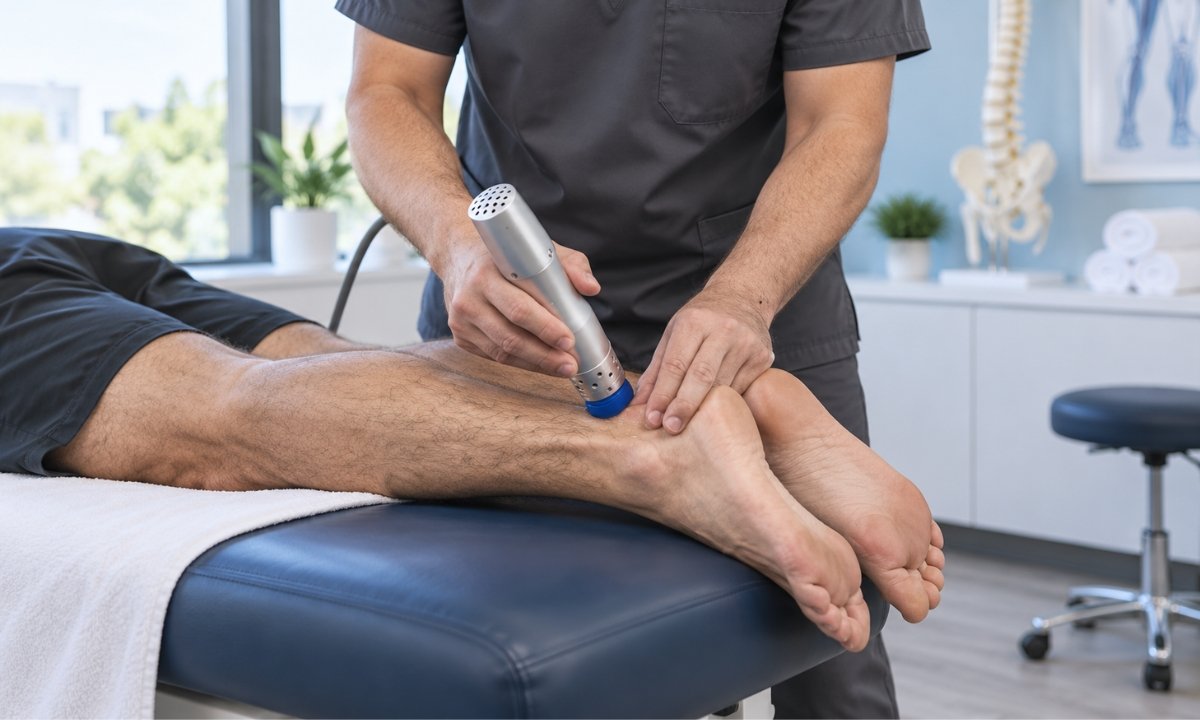
Shockwave therapy for tendon pain is a non-invasive treatment that uses pressure waves to jolt stalled, chronically irritated tissue back into a healing response. The evidence is genuinely strong for some conditions, plantar fasciitis and calcific rotator cuff tendinopathy among them, and weaker or mixed for others, including some presentations of tennis elbow and Achilles tendinopathy. It is not a stand-alone cure. In this Midtown Manhattan practice, the best outcomes happen when shockwave is paired with activity modification, progressive loading, and nutritional support, not used as a substitute for diagnosis or rehab. If you’re considering it, the honest answer is: probably, for the right condition, if you give it a full protocol and pair it with the rest of the plan.
What Is Shockwave Therapy and Why Are People Concerned About It
Shockwave Therapy is a non-surgical treatment that delivers controlled pressure waves through the skin into tendon or soft tissue that has stopped healing on its own. People usually look into it after months of physical therapy, stretching, rest, and anti-inflammatories have stalled out, and the pain keeps circling back. The concern that comes up most in my office is whether pressure waves aimed at an already painful tendon could make things worse. It’s a reasonable question, and it deserves a direct answer rather than a marketing one.
Does Shockwave Therapy Really Work for Tendon Pain
Shockwave therapy for tendon pain works well for some conditions and inconsistently for others, so the honest answer depends on which tendon and how long the problem has been going on. In my own practice, I use it most often for chronic tendinopathies, stubborn trigger points, plantar fasciitis and heel pain related to heel spurs, and post-surgical or injury-related scar tissue. The strongest and most consistent results I see are with chronic tendon pain that has already failed conventional treatment, meaning stretching, rest, and standard physical therapy provided only temporary relief.
That consistency is backed by research, not just clinical impression. A 2024 systematic review and meta-analysis of randomized controlled trials found that extracorporeal shockwave therapy reduced pain across multiple tendinopathies compared with control treatment, a finding that matches what I see with patients who’ve already tried the conservative route without success (a 2024 meta-analysis on shockwave therapy across tendinopathies).
How Shockwave Therapy Works to Support Tendon Healing
The treatment works by delivering a mechanical stimulus to tissue that has essentially given up on healing itself, prompting the body to restart a repair process it had stalled on. I explain to patients that the goal isn’t to mask pain, it’s to reactivate healing in tissue that has become difficult to heal on its own. Research on the biological effects of shockwave in tendon tissue describes this as a dose-dependent stimulus, meaning the right amount triggers a repair cascade while too much can actually cause tissue injury, which is why dosing and technique matter (a systematic review of the biological effects of shockwave therapy in tendons).
I want to be precise here rather than overstate it. The exact mechanism is still being worked out in the research, and I’d frame it as a working clinical explanation rather than settled fact. What’s clear is that it is not simply “increasing blood flow” in the vague way that’s often marketed. It’s a targeted mechanical stimulus applied to tissue that needs a reason to start repairing itself again.
Shockwave Therapy for Plantar Fasciitis
Shockwave therapy for plantar fasciitis has some of the best supporting evidence of any tendon or fascia condition it’s used for, particularly in patients who haven’t responded to months of standard care. One case that stands out in my practice involved a patient with chronic plantar fasciitis who had already completed months of physical therapy and consistently performed home exercises, with only minimal improvement. After four shockwave therapy sessions, that patient reported at least a 50 percent reduction in pain and a noticeable improvement in walking and daily activities.
I want to be transparent about what that case does and doesn’t prove. It’s one patient’s response, not a guarantee, and plantar fasciitis has a meaningful rate of improving on its own over time regardless of what treatment is used. That said, the broader research supports what I saw clinically. A meta-analysis of randomized controlled trials found that shockwave therapy measurably decreased plantar fascia thickness on imaging, which is a structural change, not just a reported pain score (a meta-analysis on shockwave therapy and plantar fascia thickness). Other trials comparing shockwave against corticosteroid injection have found comparable symptom relief without the downsides that come with repeated steroid injections into the fascia.
Shockwave Therapy for Tennis Elbow
Shockwave therapy for tennis elbow is where I see the most inconsistent results in my own practice, and I think it’s important to say that plainly instead of glossing over it. The area is extremely sensitive, and recovery usually depends on reducing or modifying the repetitive activity that keeps irritating the tendon. Many patients stay involved in the same work, sports, or exercise that’s loading the area, so the tissue never gets a real window to recover between sessions.
That doesn’t mean shockwave can’t help tennis elbow. It means it’s less likely to succeed when the aggravating activity can’t be modified. Research on lateral epicondylitis actually shows a reasonably strong evidence base, with meta-analyses finding shockwave therapy improved both pain scores and grip strength compared with other treatments (a meta-analysis on shockwave therapy for lateral epicondylitis). But a poor candidate for the therapy is often someone whose condition hasn’t been properly diagnosed, who needs a different medical approach entirely, or who can’t follow the rest and rehabilitation recommendations that make the treatment work. The tendon can respond well to the stimulus and still lose ground if it’s reloaded the same way every day.
How Many Shockwave Therapy Sessions Does It Take
A typical shockwave therapy protocol in this practice starts at a minimum of four sessions, scheduled once a week, though the best results tend to come from a full series of six treatments. Some patients notice reduced pain or better movement after the first couple of sessions, but I’m upfront that the effect is cumulative rather than immediate. The stimulus is meant to kick off a healing response, so improvement typically continues gradually through the series and often keeps building even after treatment ends.
I generally ask patients to complete at least two sessions before we evaluate their early response, since one treatment isn’t enough information to judge whether it’s working. If someone stops after a single session because they didn’t feel an immediate change, they haven’t actually given the therapy a fair test.
What Shockwave Therapy Does Not Do on Its Own
Shockwave therapy is a tool within a broader treatment plan, not a stand-alone cure, and I disagree with marketing that frames it otherwise.
It does not replace proper diagnosis or address every factor contributing to the condition. In my experience, the best outcomes occur when shockwave therapy is combined with appropriate chiropractic care, activity modification and rest, progressive rehabilitation, and nutritional support when indicated.
In practice, that means I most often pair Shockwave Therapy Sessions with chiropractic care, soft-tissue work, mobility exercises, and a gradual strengthening program that addresses both the painful tissue and the mechanical factors driving it. When it fits the patient’s history and needs, I may also discuss nutritional support such as curcumin or turmeric, boswellia, omega-3 fatty acids, and proteolytic enzymes, always individualized to the person’s health history and medications rather than handed out as a blanket recommendation.
Outcomes are consistently better when the therapy is part of that broader plan than when it’s used in isolation. Movement correction, progressive tendon loading, nutrition, and recovery time all help the tissue adapt, and that’s what reduces the chance of the problem simply returning a few months later.
The Biggest Misconception About Shockwave Therapy
The most common misconception is that shockwave therapy is invasive or that the pressure waves might further injure an already painful tendon. There’s no incision and no injection involved. The treatment delivers controlled mechanical pressure waves to the affected tissue as a therapeutic stimulus, and patients may feel temporary discomfort during the session or mild soreness afterward, which is a very different thing from causing further injury. The intensity gets adjusted to the patient’s tolerance and the specific condition being treated, which is also why working with an experienced provider matters more than the device itself.
Who Should Actually Consider Shockwave Therapy for Tendon Pain
The typical patient who ends up asking about shockwave therapy for tendon pain has already tried physical therapy, home exercises, and rest, and is frustrated that the pain keeps coming back. Many are also worried that injections or surgery are their only remaining options. If that description fits you, shockwave therapy may be a reasonable non-invasive option to explore before more aggressive interventions, provided the diagnosis is accurate and you’re willing to pair it with rest, rehab, and supportive care rather than expecting the sessions alone to do all the work.
It is not guaranteed to work for everyone. But for the right diagnosis, combined with the right supporting plan, it’s a legitimate option worth understanding before ruling it out or jumping straight to surgery.
Key Takeaways
Shockwave therapy for tendon pain has strong supporting evidence for plantar fasciitis and reasonably strong evidence for lateral epicondylitis, with more mixed results depending on the specific tendon and how chronic the condition is.
A full protocol typically runs four to six weekly sessions, and the effect builds cumulatively rather than resolving after one visit.
Results are consistently better when shockwave is combined with activity modification, chiropractic care, progressive rehab, and nutritional support, not used alone.
Tennis elbow tends to respond less predictably specifically because the aggravating activity is harder for most patients to modify.
It is non-invasive, but not painless, and it is not a substitute for an accurate diagnosis.
Related Reading
- The most common questions about shockwave therapy, from what it treats to recovery time
- A closer look at whether radial shockwave therapy is effective
- Natural alternatives to prescription medications for musculoskeletal pain
Frequently Asked Questions
Does shockwave therapy hurt?
Shockwave therapy typically causes some discomfort during the session and mild soreness for a day or two afterward, but it is not designed to injure the tendon. The intensity is adjusted to each patient’s tolerance and the condition being treated.
How soon will I feel results from shockwave therapy?
Some patients notice a change after the first couple of sessions, but the effect is cumulative. A full protocol of four to six weekly sessions is generally needed before you can fairly judge whether it worked, and improvement often continues even after the sessions end.
Is shockwave therapy better than a cortisone injection?
For plantar fasciitis specifically, research comparing shockwave therapy to corticosteroid injection has found comparable symptom relief without the risks that come with repeated steroid injections into the fascia. The right choice depends on the individual case and how the condition has responded to prior treatment.
Can shockwave therapy make tendon pain worse?
When dosed and applied appropriately by an experienced provider, shockwave therapy is not expected to worsen tendon pain. Research on its biological effects in tendon tissue notes that the stimulus is dose-dependent, meaning appropriate intensity supports healing while excessive intensity can be counterproductive, which is why technique and experience matter.
Who is not a good candidate for shockwave therapy
Poor candidates typically include patients whose pain hasn’t been accurately diagnosed, whose condition needs a different medical approach altogether, or who are unable or unwilling to modify the repetitive activity aggravating the tendon or follow the rest and rehab plan that supports the treatment.
A Final Thought
The question isn’t really whether shockwave therapy works. It’s whether you’re willing to give it a real trial, four to six full sessions, paired with the activity changes and rehab that let the tissue actually use the healing signal it’s being given. Skip that pairing, and you’re left wondering why a treatment with real evidence behind it didn’t do much for you.
References
- Majidi L, Khateri S, Nikbakht N, Moradi Y, Nikoo MR. The effect of extracorporeal shock-wave therapy on pain in patients with various tendinopathies: a systematic review and meta-analysis of randomized control trials. BMC Sports Sci Med Rehabil. 2024. https://www.ncbi.nlm.nih.gov/pmc/articles/PMC11041007/
- Poenaru D, Sandulescu MI, Cinteza D. Biological effects of extracorporeal shockwave therapy in tendons: A systematic review. 2023. https://pubmed.ncbi.nlm.nih.gov/36684664/
- Authors reported in Springer Archives of Orthopaedic and Trauma Surgery. Effect of extracorporeal shockwave therapy on plantar fascia thickness in plantar fasciitis: a systematic review and meta-analysis of randomized controlled trials. 2024. https://link.springer.com/article/10.1007/s00402-024-05464-6
- Yao G, Chen J, Duan Y, Chen X. Efficacy of Extracorporeal Shock Wave Therapy for Lateral Epicondylitis: A Systematic Review and Meta-Analysis. Biomed Res Int. 2020. https://www.ncbi.nlm.nih.gov/pmc/articles/PMC7106907/
- Feeney KM. The Effectiveness of Extracorporeal Shockwave Therapy for Midportion Achilles Tendinopathy: A Systematic Review. Cureus. 2022. https://www.ncbi.nlm.nih.gov/pmc/articles/PMC9382436/
FDA Disclaimer
This article is for educational purposes only and has not been evaluated by the Food and Drug Administration. It is not intended to diagnose, treat, cure, or prevent any disease, and it is not a substitute for individualized medical advice from a licensed healthcare provider. Always consult a qualified practitioner before starting any new treatment for tendon pain or any other condition.
Author: Aleksander Kanevsky, DC, CFMP
Article by Aleksander Kanevsky, DC, CFMP





