
Peptides are showing up everywhere, from TikTok feeds to biohacking forums, and more people are buying them online without fully understanding what they are actually getting. There is a critical difference between research grade peptides, sold with a “not for human consumption” label, and prescription grade peptides compounded by a licensed pharmacy. That difference is not just about quality. It is about safety, legality, contamination risk, and whether what is in the vial is actually what it says on the label. This article breaks down the real distinctions, what to look for, and why the cheapest option could cost you far more than money.
What Are Research Grade Peptides, and Why Is Everyone Confused About Them?
Peptides are short chains of amino acids, the same building blocks that make up proteins. Your body produces them naturally, and they play roles in everything from cellular repair to immune signaling to metabolism. Over the last few years, peptide therapy has moved from specialty clinics into the mainstream, driven by GLP-1 medications like semaglutide, growing interest in longevity medicine, and an enormous amount of social media content around biohacking.
With that popularity came a flood of online vendors selling peptides, cheaply and without much friction, to anyone willing to click “add to cart.” These are what is known as research grade peptides, also called research chemicals or “RUO” (research use only) compounds. They are labeled “not for human consumption” and technically sold for laboratory use.
Here is the part most buyers skip: that label is not a loophole, and it is not a wink-and-nod legal technicality. It means exactly what it says. And the distinction between these products and what a licensed compounding pharmacy prepares for a patient under a physician’s prescription is enormous.
The “Not for Human Consumption” Label Is Not a Technicality
Let’s be direct here. When a vial shows up at your door with “not for human consumption” printed on it, the legal purpose of that language is to protect the vendor, not you.
As one pharmaceutical compliance resource makes it plain: “The ‘not for human consumption’ label found on research-grade products is not a legal loophole or a mere formality. It is a literal regulatory status.”
What does that mean practically? Research grade peptides are typically produced to analytical or chemical grade standards. That means they are verified to be a specific molecule for purposes of laboratory analysis. They are not tested for endotoxins. They are not required to be sterile. There is no chain-of-custody documentation. There is no requirement to test for heavy metals, residual solvents, or bacterial contamination.
You are injecting something that has never been evaluated for biological safety in the human body.
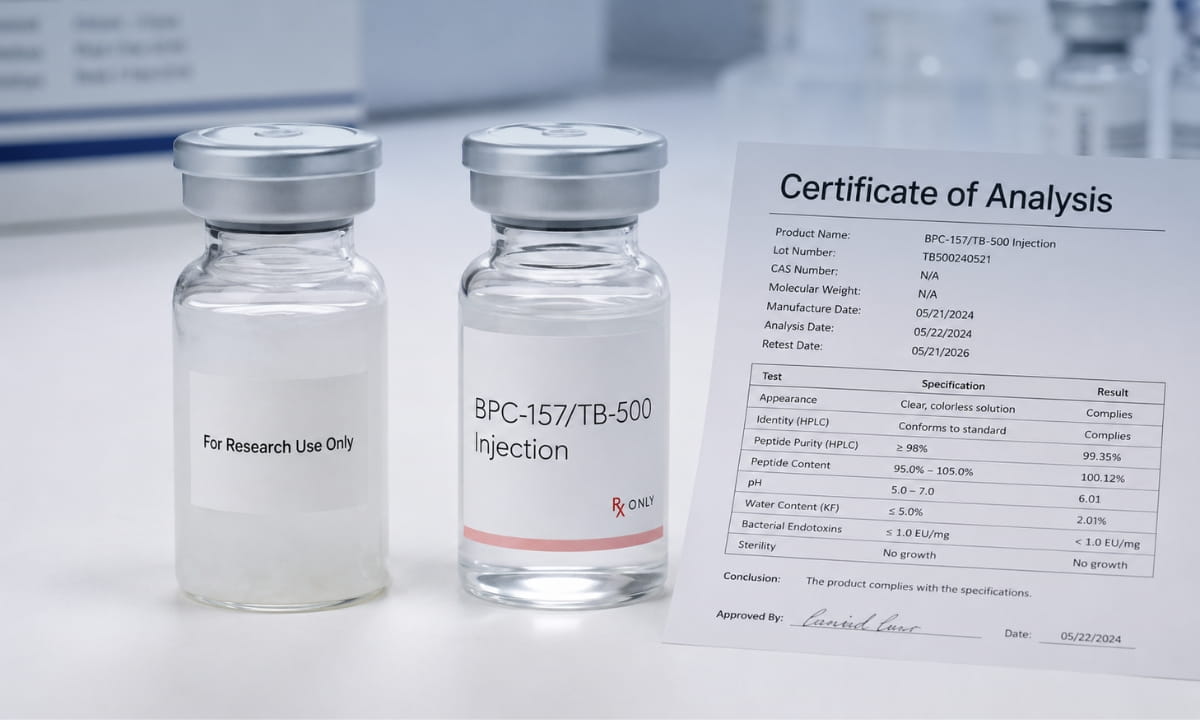
Contrast that with what a legitimate 503A and 503B compounding pharmacy does before a single vial ships. The pharmacist sources the active pharmaceutical ingredient from an FDA-registered supplier with a Certificate of Analysis. The compound is prepared in a sterile environment meeting USP 797 standards. It is then tested for potency, sterility, endotoxins, and moisture content before release. You receive the exact dose prescribed by a licensed physician, prepared to a standard designed for human administration.
The molecule may be chemically identical. Everything around it is not.
What the Research Actually Shows About Contamination Risk
This is not theoretical risk. Independent testing of peptides sold online has identified heavy metals, endotoxins, undisclosed fillers, and dosing inconsistencies in products labeled research grade. Studies and industry analyses have found that a significant percentage of online peptide supplements may be contaminated or mislabeled.
Endotoxins, which are bacterial cell wall fragments, are a particular concern with injectable compounds. Even small quantities injected into the bloodstream can trigger a systemic inflammatory response, fever, or septic-type reaction. This is precisely why pharmaceutical compounding facilities are required to test for endotoxin levels below 0.25 EU/mg, a threshold that research chemical suppliers are under no obligation to meet.
Heavy metal contamination from unregulated overseas manufacturing is another documented issue. Many research peptide suppliers source from foreign facilities with no requirement to meet US cGMP (Current Good Manufacturing Practice) standards or submit to FDA oversight.
The practical summary: when you skip the prescription pathway, you skip every layer of protection designed to ensure that what you inject is actually safe.
The Gold Standard: What 503A and 503B Certification Actually Means
When you see a reference to a 503A compounding pharmacy or a 503B outsourcing facility, those are specific legal designations under the Federal Food, Drug, and Cosmetic Act. They are not marketing claims. They are regulatory classifications, and they are not interchangeable. Understanding the difference between the two helps you know exactly what kind of oversight sits behind the product you receive.
503A Compounding Pharmacy: Personalized and Patient-Specific
A 503A pharmacy is what most people encounter through telehealth providers and direct-to-patient peptide prescribing. The model works like this: a licensed physician prescribes a specific compound at a specific dose for you, and the pharmacy compounds it to fill that individual prescription. The facility is regulated by the FDA and your state board of pharmacy, must follow USP 797 sterile compounding standards, and sources its active pharmaceutical ingredients from FDA-registered domestic suppliers with documented Certificates of Analysis. Products are prepared in a sterile environment and tested for potency, sterility, and endotoxins before they ship to your door.
The 503A model also requires a valid prescriber-patient relationship before anything is compounded. You cannot simply place an order. A physician reviews your case, and the pharmacy fills what that physician prescribes. That structure is a safety feature, not a bureaucratic inconvenience.
503B Outsourcing Facility: Batch Manufacturing Under FDA Inspection
503B outsourcing facilities were created by the Drug Quality and Security Act of 2013 and represent a higher tier of manufacturing scrutiny. These are not traditional pharmacies. They are FDA-registered outsourcing facilities that can compound medications in larger batches without patient-specific prescriptions, primarily supplying hospitals, clinics, and medical offices rather than shipping directly to individual patients.
What sets 503B apart is that these facilities must operate under full cGMP (Current Good Manufacturing Practice) standards, the same class of requirements applied to pharmaceutical manufacturers. They are subject to regular FDA inspections, must validate every process and production batch, and submit products for stability testing before release. As of late 2024, only around 86 facilities nationally held active 503B registration, which tells you how rigorous the entry requirements are.
If you receive a compounded peptide administered in a clinical setting, a physician’s office, or through a supervised wellness program, there is a reasonable chance it came from a 503B facility. If you are using a telehealth model that ships to your home, it almost certainly comes from a 503A pharmacy.
What Both Pathways Share
Both 503A and 503B facilities share the features that matter most when you are comparing them to anything sourced from the gray market: US-based manufacturing, sterile preparation under controlled conditions, third-party testing and documentation, and accountability to a regulatory body that can inspect, cite, and shut down non-compliant facilities.
Neither pathway is available to the vendor selling you a “research use only” vial online. That vendor answers to no pharmacy board, submits to no FDA inspection, and produces no Certificate of Analysis that meets pharmaceutical standards. That gap is the entire argument.
NABP Accreditation
An additional layer worth checking is NABP (National Association of Boards of Pharmacy) accreditation. This is a voluntary certification that confirms a pharmacy is operating legally and ethically, particularly important for pharmacies operating in the telehealth and digital health space where verification is harder for patients to do on their own.
US-Based Manufacturing
Sourcing from domestic FDA-registered facilities removes the contamination risks that come with overseas and unregulated foreign labs, where oversight is essentially nonexistent.
None of this is luxury. It is the baseline for what you should expect when something enters your body via injection.
Why the Price Difference Exists (And What It’s Really Covering)
Research grade peptides are cheaper for a straightforward reason: they skip all of the above. No sterility testing. No endotoxin panels. No physician oversight. No NABP accreditation. No Certificate of Analysis verified for pharmaceutical use. No support structure if something goes wrong.
When you pay for a prescription grade compounded peptide through a licensed telehealth model, the price includes the clinical infrastructure around the compound: the initial lab review, the dosing conversation with a physician, the follow-up, the sterile syringes and administration supplies, and a direct channel to a medical provider if you have a question or a reaction.
The biohacker community often frames this as “paying for the label.” It is actually paying for accountability.
As a functional medicine practitioner, I work with patients who have come to me after trying research peptides bought online. The stories follow a pattern: inconsistent results, injection site reactions, uncertainty about whether what they received matched what was advertised. Some were frankly spending money on products that had no meaningful biological activity because the compound had degraded or was underdosed to begin with.
The Regulatory Landscape Is Shifting, and That Matters
The FDA has been actively scrutinizing the peptide space. In late 2023, the agency moved over a dozen popular peptides to Category 2 of the 503A Bulks List, a designation that effectively restricted their use in legitimate compounding. Legal challenges followed, and as of 2025 and into 2026, several of those peptides are under active review for potential restoration to the compoundable list.
What that regulatory movement makes clear is that the agency’s primary concern is not whether peptides have therapeutic potential. Many clearly do. The concern is the absence of quality controls and clinical data when products are sourced outside of regulated channels.
The irony is that the FDA crackdown on compounding pushed some patients toward the gray market for access, which is precisely the opposite of what protects them. Clinics and practitioners who understand this landscape can help patients navigate toward legal, supervised pathways, even as the regulatory environment continues to evolve.
Three Questions to Ask Before You Source Any Peptide
Whether you are evaluating a telehealth provider, a wellness clinic, or any other source for peptide therapy, these three questions give you a practical safety framework:
- What is the potency, and how was it verified? Ask for a Certificate of Analysis from an independent third-party lab. A legitimate provider can produce one. An online research chemical vendor cannot produce one that meets pharmaceutical-grade standards.
- Where is it manufactured? The facility should be in the United States and FDA-registered. Products sourced from overseas chemical suppliers carry contamination risks that domestic 503A and 503B compounding pharmacies are explicitly designed to prevent.
- Is the pharmacy certified? Confirm the dispensing pharmacy holds 503A and 503B status. These are not optional markers. They are the baseline verification that the facility operates legally and to pharmaceutical standards.
If the provider or source cannot answer all three questions clearly and quickly, you have your answer.
Where Functional Medicine Fits Into This Picture
One thing that gets lost in the research vs prescription peptide debate is the question of context. Even the highest quality pharmaceutical-grade peptide is only part of the equation. For someone using sermorelin to support sleep and growth hormone recovery, for example, the outcome depends heavily on sleep architecture, cortisol rhythm, protein intake, and stress load. The peptide does not override poor fundamentals.
This is where working with a practitioner who understands both functional medicine and the peptide landscape becomes genuinely useful. It is not just about selecting the right compound. It is about identifying what your body actually needs based on labs, reviewing the interaction with any other supplements or medications you are taking, and building a protocol that makes sense for your specific goals.
For my patients in New York, that conversation typically starts with a functional medicine evaluation before we ever discuss a specific peptide or a telehealth referral. That sequencing matters.
For patients who are ready to explore peptide therapy through a supervised telehealth model with pharmaceutical-grade compounds, I refer to EllieMD (https://elliemd.com), a telehealth provider that dispenses through licensed 503A compounding pharmacies and includes physician oversight in its model. The structure, the clinical support, and the sourcing standards are what make that referral worth making.
Related Reading:
- Understanding Peptide Therapy: What a Functional Medicine Approach Actually Looks Like
– https://atlantchiropractic.com/peptides-101-safe-use-benefits-metabolic-health/ - PCOS, PMOS, and Peptide Therapy: A Functional Medicine Framework
– https://atlantchiropractic.com/pcos-pmos-peptide-therapy-metabolic-health - GLP-1, Weight Loss, and Metabolic Health: What You Should Know About Microdosing
– https://atlantchiropractic.com/glp-1-microdosing-longevity/
Closing Thought: You Are Not Just Getting a Compound
The deepest issue here is not really about research grade peptides vs prescription grade peptides. It is about what kind of health decision you are making and with what information.
The gray market sells you a vial. The prescription pathway sells you an outcome, backed by a verified compound, a physician, and a support structure that exists if something does not go as planned.
If you are serious about peptide therapy as part of a longevity or metabolic health strategy, the question worth sitting with is this: you already track your sleep, your labs, your nutrition. You are precise about everything else in your health optimization. Why would you accept an unknown variable at the injection site?
Frequently Asked Questions About Research Grade vs Prescription Grade Peptides
Are research peptides illegal to buy?
Research peptides exist in a legal gray area. Purchasing them for personal use is not always explicitly illegal, but using them in humans violates the “not for human consumption” designation and bypasses every regulatory safeguard designed to protect you. The vendor is protected by the label. You are not.
Is the molecule itself different between research grade and pharmaceutical grade?
The amino acid sequence can be identical. What differs is everything surrounding it: the sterility of the manufacturing environment, contamination testing, potency verification, shelf stability, and the clinical oversight around how it is used. The compound is the same in the same way that food prepared in a licensed commercial kitchen and food prepared in an unregulated warehouse might use the same ingredient. The context determines the safety.
What is a 503A compounding pharmacy?
A 503A compounding pharmacy is a facility regulated under the Federal Food, Drug, and Cosmetic Act by the FDA and state pharmacy boards to prepare patient-specific medications. For peptides, this means sourcing pharmaceutical grade active ingredients, preparing them in sterile conditions that meet USP 797 standards, and testing the final product for potency, sterility, and endotoxins before dispensing to a patient with a valid prescription from a licensed physician.
What is a 503B compounding pharmacy?
A 503B outsourcing facility is a higher-tier compounding designation created by the Drug Quality and Security Act of 2013. Unlike a 503A pharmacy, a 503B facility can manufacture medications in larger batches without a patient-specific prescription, supplying hospitals, clinics, and medical offices rather than shipping directly to individual patients.
Both 503A and 503B represent legitimate, regulated pathways. What they have in common is the one thing the gray market cannot offer: documented accountability to a regulatory body with the authority to inspect and enforce.
Can I get prescription grade peptides without seeing a doctor in person?
Yes. Telehealth providers can evaluate a patient, review labs, and issue a prescription that a certified compounding pharmacy then fills and ships directly. This model makes supervised, pharmaceutical-grade peptide therapy accessible without requiring in-person visits for every touchpoint.
Why are online research peptides so much cheaper?
Because they skip the testing, the regulatory compliance, the sterile manufacturing requirements, and the clinical oversight that prescription grade products require. Lower price reflects lower safety infrastructure. It is not a bargain. It is a different product.
What are the real contamination risks from research grade peptides?
Independent testing has identified endotoxins, heavy metals, undisclosed fillers, and significant potency variation in research grade peptides sold online. Endotoxins injected into the bloodstream can cause systemic inflammation. Heavy metals accumulate with repeated exposure. Inaccurate dosing creates unpredictable biological effects, which is a safety risk regardless of which direction the error runs.
How do I find a practitioner who can guide me on peptide therapy?
Look for a functional medicine practitioner, integrative physician, or DC with CFMP credentials who works within a supervised telehealth model. They can evaluate your labs, explain the clinical rationale for specific peptides, and refer you to a legitimate 503A compounding pharmacy for any prescribing that falls within medical scope.
References
- U.S. Food and Drug Administration. (2023). Bulk Drug Substances Nominated for Use in Compounding Under Section 503A of the Federal Food, Drug, and Cosmetic Act. FDA.gov. https://www.fda.gov/drugs/human-drug-compounding/human-drug-compounding-policies-and-rules
- American Wellness Pharmacy. (2025). Chemical Peptides vs. Pharmaceutical Grade Peptides. Regulatory Education Series. https://www.americanwellnesspharmacy.com/regulatory/chemical-peptides-vs-pharmaceutical-grade-peptides/
- United States Pharmacopeia. USP General Chapter 797: Pharmaceutical Compounding, Sterile Preparations. https://www.usp.org/compounding/general-chapter-797
- MD Pilot. (2025). Peptide Safety and Side Effects: Latest Research, Risks, and FDA Warnings. https://md-pilot.com/are-peptides-safe-latest-research-risks-and-side-effects-2024-2025/
- Health Law Alliance. (2026). Peptides: Legal and Regulatory Risks 503A Compounding Pharmacies Must Understand. https://www.healthlawalliance.com/blog/peptides-legal-and-regulatory-risks-503a-compounding-pharmacies-must-understand
- Rethink Peptides. (2026). Research-Grade Peptides and Human Use: Where the Law Draws the Line. https://rethinkpeptides.com/articles/research-grade-peptides-and-human-use-where-the-law-draws-the-line
- Real Peptides. (2026). Research Peptides vs Pharmaceutical Grade: Labels Explained. https://www.realpeptides.co/research-peptides-vs-pharmaceutical-grade-labels/
- Fierce Pharma. (2026). FDA Advisory Committee Set to Weigh Action on Certain Unapproved Peptides. https://www.fiercepharma.com/pharma/fda-advisory-committee-set-weigh-taking-action-certain-unapproved-peptides
FDA Disclaimer: The information provided in this article is for educational purposes only and does not constitute medical advice, diagnosis, or treatment recommendations. Peptide therapy involves compounds that may be regulated by the U.S. Food and Drug Administration. Any therapeutic use of peptides should occur only under the supervision of a licensed healthcare provider. The statements in this article have not been evaluated by the Food and Drug Administration. This content is not intended to diagnose, treat, cure, or prevent any disease or health condition.
Article by Aleksander Kanevsky, DC, CFMP
 At New York City Chiropractic and Functional Medicine Center, Dr. Aleksander Kanevsky provides Chiropractic Care, Bioenergetic Medicine, Functional Medicine and Nutrition. Dr. Kanevsky demonstrates why this type of integrative care is an essential addition to a health care practice. He helps people to achieve quality of life and highest expression of health.




