

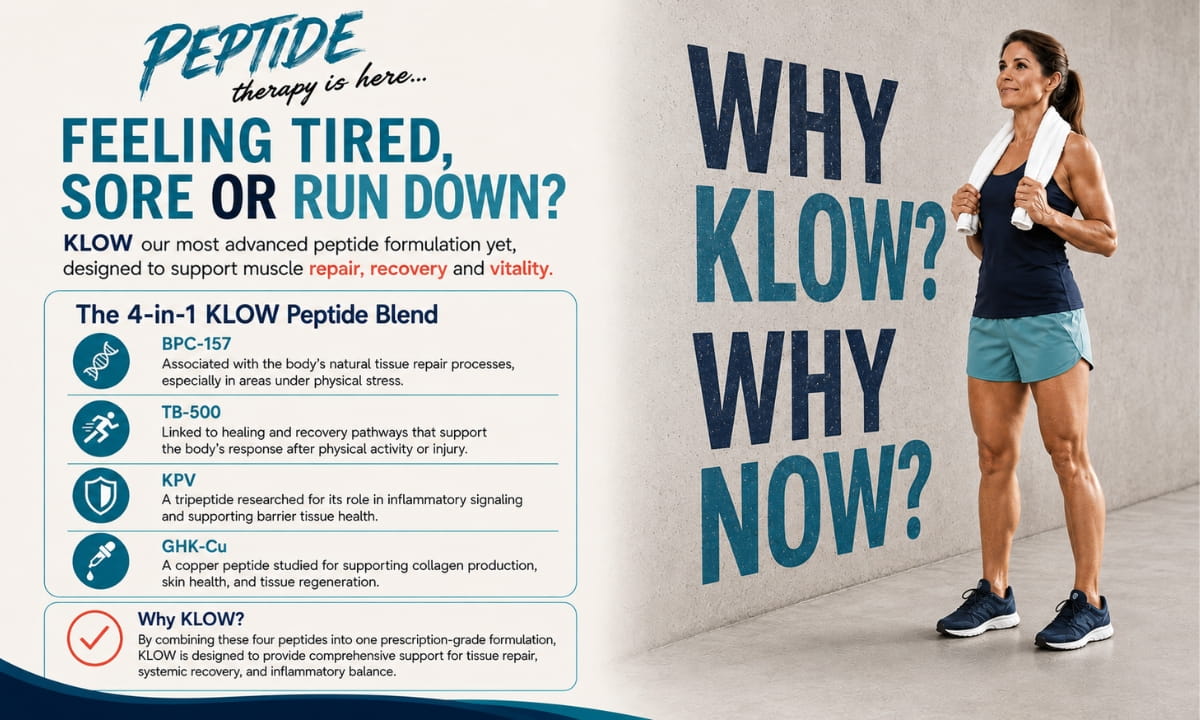
KLOW is the name for a four-peptide blend, BPC-157, TB-500, KPV, and GHK-Cu, combined into one formulation to target tissue repair, systemic recovery, inflammation, and skin renewal at once. The name isn’t owned by one company. It’s sold both as an unregulated research chemical online and as a pharmacy compounded medication through licensed providers, and the difference between those two versions matters more than almost anything else in this category.
What Is KLOW, and Why Do So Many Different Versions of It Exist?
KLOW isn’t a brand. It’s become the working name for a specific four-peptide combination that keeps showing up across the peptide world under the same four letters, no matter who’s selling it. Search the term and you’ll find it everywhere from research-chemical suppliers marketing 80mg vials as “for laboratory use only” to licensed telehealth platforms offering it as a physician-prescribed injection.
That range is the whole story. Same four peptides, same theoretical mechanism, dramatically different manufacturing standards, oversight, and legal status depending on where it comes from.
Where Does the Name “KLOW” Actually Come From?
There’s no single company or scientist credited with inventing KLOW, and that’s worth knowing before you evaluate any claims about it. The name grew out of an earlier three-peptide combination nicknamed “GLOW,” pairing BPC-157, TB-500, and GHK-Cu. When KPV was added for its anti-inflammatory effect, the name shifted to KLOW. It’s an industry nickname that stuck, not a patented formula or a trademarked product, which is exactly why so many different suppliers, from unregulated research-chemical vendors to licensed compounding pharmacies, use the same four letters for formulations that can vary meaningfully in dose ratio, purity, and quality control.
What’s Actually Inside the KLOW Peptide Blend
Each of the four peptides in KLOW targets a different piece of how the body repairs itself, which is the actual rationale for combining them rather than using one alone.
BPC-157 is derived from a protein found in human gastric juice. In preclinical models it’s been studied for stimulating new micro-capillary growth at injury sites and supporting tendon-to-bone reattachment. A small human case series published in Alternative Therapies in Health and Medicine documented improvement in several types of knee pain following intra-articular injection, real clinical observation, though not a controlled trial.
TB-500, a synthetic fragment of thymosin beta-4, works differently. It regulates actin, the protein cells use to migrate, which helps repair cells travel to damaged tissue and reduces the restrictive scar tissue that limits mobility after injury. The deepest evidence here comes from cardiac repair research, still largely preclinical.
KPV, a three-amino-acid fragment of alpha-MSH, is the anti-inflammatory piece. It enters cells via the PepT1 transporter and interrupts NF-kB, the switch that turns on inflammatory cytokine production. The foundational research showing this effect was published in Gastroenterology using colitis models.
GHK-Cu is the one with genuine human clinical data behind it. A randomized, double-blind trial found topical GHK-Cu measurably increased skin thickness, elasticity, and collagen density compared to control, a real, replicated human outcome, not projected from animal data.
For a deeper mechanistic comparison of how these first three peptides interact, our full BPC-157 vs. TB-500 vs. KPV breakdown covers the biology in more depth.
How Do You Combine Four Different Peptides Into One Stable Formulation?
This is a harder problem than it sounds, and it’s worth understanding before assuming any KLOW vial is formulated the same way.
BPC-157, TB-500, KPV, and GHK-Cu are not chemically similar. BPC-157 and TB-500 are peptide chains with their own solubility and degradation profiles. KPV is a much smaller tripeptide with different stability behavior in solution. GHK-Cu is a copper-binding peptide, its copper ion changes how it behaves in water entirely compared to the other three. Combine all four in a single liquid vial and you’re managing four different degradation clocks at once, not one.
That’s why legitimate multi-peptide formulations, whether research-grade or pharmacy-compounded, are typically supplied as a lyophilized (freeze-dried) powder rather than a pre-mixed liquid. Freeze-drying removes the water that drives most peptide degradation, which is what allows a four-peptide blend to sit on a shelf at all. Pharmaceutical peptide formulation science generally relies on a buffering agent, commonly histidine or phosphate-based, to hold the solution at a stable pH range during and after reconstitution, along with a lyoprotectant like sucrose or mannitol that protects the peptide structure through the freezing and drying process itself.
Getting that combination right matters more with a four-peptide blend than a single peptide, because the buffer and pH that keep GHK-Cu stable aren’t automatically the same conditions that keep BPC-157 or KPV stable. This is precisely where sourcing quality shows up in practice, not just in the marketing language. A licensed compounding pharmacy validates formulation stability as part of USP-standard sterile compounding. A research-chemical vendor selling an unregulated vial may or may not have done that work at all, and there’s typically no way for a buyer to verify it.
Research Grade vs. Pharmacy-Compounded Grade: Why the Same Four Letters Mean Different Things
This is the part that actually determines whether a KLOW protocol is a reasonable decision or a real risk.
Research-grade KLOW is sold by independent chemical suppliers labeled “not for human consumption,” with no FDA oversight, no guarantee of sterility or accurate dosing, and batch quality that varies supplier to supplier. Some provide a certificate of analysis. Many don’t. There’s no licensed clinician involved at any point in that transaction.
Pharmacy-compounded KLOW is available from FDA-registered 503A or 503B pharmacies, prescribed by a licensed medical provider after an actual health evaluation, tested for purity and potency on every batch, and dosed to your specific labs and history rather than a generic protocol. EllieMD, the telehealth platform I work with as an affiliate partner, is one example of this pathway, offering a KLOW formulation through licensed prescribers with pharmacy-grade sourcing standards.
The peptides in the vial might be chemically identical on paper. What surrounds them, oversight, testing, dosing accuracy, is not.
Recovery Doesn’t Start or End With the Vial
Peptides send signals. They don’t correct the mechanical or nutritional conditions those signals are trying to work within. A functional medicine approach layers a KLOW protocol on top of the fundamentals that make repair possible in the first place, adequate protein for collagen synthesis, deep sleep for tissue repair, stress and cortisol management, and correcting the mechanical stress patterns that keep re-injuring the same tissue. Baseline labs, and in some cases hair tissue mineral analysis, confirm your body actually has the zinc, copper, and magnesium needed to execute the repair those peptides are signaling for.
Key Takeaways
- KLOW is a generic name for a four-peptide combination (BPC-157, TB-500, KPV, GHK-Cu), not a single company’s proprietary product
- The same name is used for both unregulated research-chemical products and prescription-grade compounded medications, and the difference is significant
- GHK-Cu has the strongest human clinical evidence in the blend; TB-500 and KPV remain largely preclinical
- Pharmacy-compounded KLOW requires a licensed provider evaluation, pharmacy-grade sourcing, and per-batch testing that research-grade versions don’t have
- A KLOW protocol works best alongside nutrition, sleep, stress management, and mechanical correction, not as a standalone fix
Frequently Asked Questions
What does KLOW actually do?
It combines structural tissue repair (BPC-157), systemic cell migration and scar reduction (TB-500), inflammatory signaling control (KPV), and collagen production (GHK-Cu) into one protocol addressing several recovery pathways simultaneously.
Is KLOW the same everywhere it’s sold?
No. The name refers to the same four-peptide combination, but the manufacturing standard, oversight, and legal status vary enormously depending on whether it’s sold as a research chemical or compounded by a licensed pharmacy under prescription.
Is KLOW legal?
Prescription-grade KLOW compounded by a licensed 503A or 503B pharmacy under a valid prescription is legal. Research-grade KLOW sold as “not for human consumption” exists in a legal gray zone that shifts responsibility, and risk, entirely onto the buyer.
Do you need a prescription for KLOW?
For the pharmacy-grade version, yes. A licensed medical provider evaluates your health history and labs before prescribing, and the formulation is compounded specifically for you.
Where does the name KLOW come from?
KLOW isn’t a trademarked or patented formula. It grew out of an earlier three-peptide blend nicknamed “GLOW” (BPC-157, TB-500, GHK-Cu), with KPV added later to create the four-peptide version now called KLOW. No single company or researcher is credited as its formulator.
Why is it harder to formulate a four-peptide blend than a single peptide?
BPC-157, TB-500, KPV, and GHK-Cu each have different solubility, pH sensitivity, and degradation behavior, GHK-Cu’s copper-binding structure in particular behaves differently in solution than the other three. Stabilizing all four in one formulation typically requires lyophilization along with a validated buffer and lyoprotectant system, which is a more demanding formulation process than stabilizing a single peptide alone.
How is EllieMD’s KLOW different from research-grade versions online?
EllieMD sources KLOW through FDA-registered compounding pharmacies with per-batch purity and sterility testing, and every prescription is reviewed by a licensed provider based on individual health history, not sold without medical oversight.
Related Reading
- BPC-157 vs. TB-500 vs. KPV: Which Regenerative Peptides Are Right for Your Healing and Tissue Repair?
- Thymosin Alpha-1 for Immune Support: What the Research Actually Shows
- PCOS Renamed PMOS: Peptide Therapy for Metabolic Health
Is a KLOW Protocol Actually Right for What You’re Dealing With?
The honest answer depends on labs, history, and what’s actually driving your symptoms, not on which vendor’s version shows up first in a search. If you’re considering a personalized peptide protocol, that conversation should start with an evaluation of your specific case, not a generic dose copied from a forum.
References
- Lee E, Padgett B. Intra-Articular Injection of BPC 157 for Multiple Types of Knee Pain. Altern Ther Health Med. 2021;27(4). https://pubmed.ncbi.nlm.nih.gov/34324435/
- Thymosin β4: multiple functions in protection, repair and regeneration of the mammalian heart. PubMed. https://pubmed.ncbi.nlm.nih.gov/26094634/
- Dalmasso G, Charrier-Hisamuddin L, Nguyen HTT, et al. PepT1-mediated tripeptide KPV uptake reduces intestinal inflammation. Gastroenterology. 2008;134(1):166-178. https://pubmed.ncbi.nlm.nih.gov/18061177/
- Regenerative and Protective Actions of the GHK-Cu Peptide in the Light of the New Gene Data. PMC. https://pmc.ncbi.nlm.nih.gov/articles/PMC6073405/
This article is for educational purposes only and does not constitute medical advice. BPC-157, TB-500, and KPV have not been evaluated by the Food and Drug Administration and are not approved to diagnose, treat, cure, or prevent any disease. Compounded medications are not FDA-approved and are not evaluated by the FDA for safety, effectiveness, or quality. Much of the available research is preclinical or limited to small human studies. Consult a licensed healthcare provider before starting any peptide protocol.
Disclosure: I may earn a commission if you sign up through my telemedicine platform link. All medical care is provided by licensed physicians.
Article by Aleksander Kanevsky, DC, CFMP
 At New York City Chiropractic and Functional Medicine Center, Dr. Aleksander Kanevsky provides Chiropractic Care, Bioenergetic Medicine, Functional Medicine and Nutrition. Dr. Kanevsky demonstrates why this type of integrative care is an essential addition to a health care practice. He helps people to achieve quality of life and highest expression of health.




